Teaching English to Kids at Home: Phonics, Words and Reading
Teaching English to kids in Qatar at home: phonics basics, vocabulary in context and shared reading, plus signs your child needs a structured program.
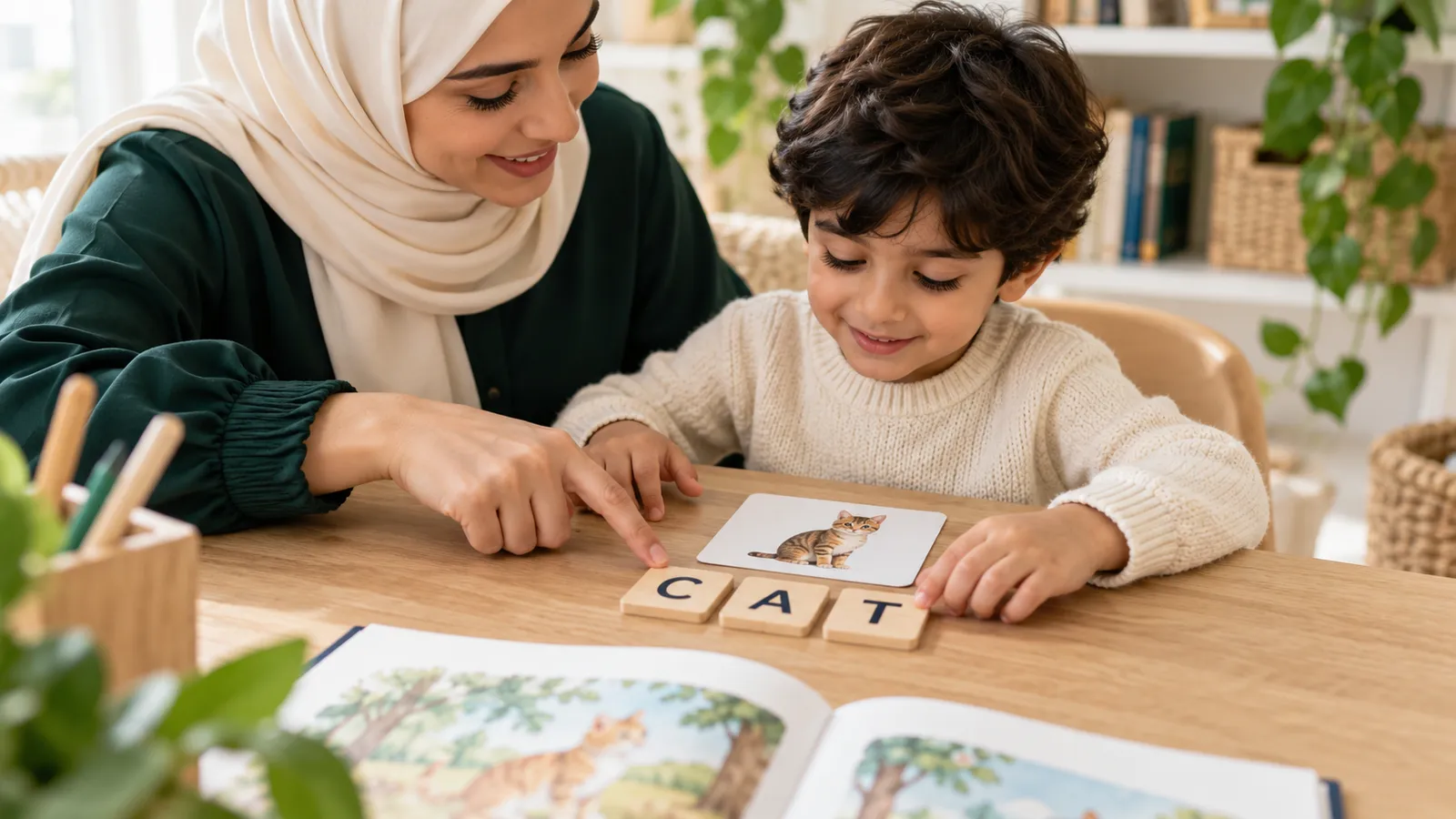
Teaching English to kids at home is possible even if you are not a fluent English speaker yourself. In the early years children do not need complicated grammar. They need a solid base built on three things: phonics, so they connect sounds to letters; vocabulary learned in context, so new words stick; and regular shared reading. Here is a practical plan for parents in Qatar who want to start at home, plus the signs that tell you a child needs more structured support.
Why phonics comes first when teaching English to kids
Many children can sing the alphabet song perfectly and still freeze in front of a simple word. The reason is that a letter's name is not the sound it makes inside a word. Phonics teaches the sound each letter or letter group makes, so a child can work out words they have never seen before instead of memorising every word as a picture.
Phonics at home: where to begin
Start with short letter sounds and a small set of letters that already make real words, such as s, a, t, p, i and n. Together they give you sat, pin, tap and nap. Then build step by step:
- One sound per letter, with an action or picture to help it stick.
- Blending three sounds into a short word, such as c-a-t.
- Segmenting: hearing a word and breaking it back into its sounds, which is the foundation of spelling.
- Two-letter sounds such as sh, ch, th and ee.
- Common "tricky" words that do not follow the rules, such as the, said and was, learned by sight.
One important tip: keep each sound short and clean. The sound of m is "mmm", not "muh". That extra vowel makes blending much harder for a young learner.
Vocabulary in context, not in lists
A list of twenty words is quickly forgotten; a word a child uses in a real moment stays. Make English a small part of everyday routines:
- In the kitchen: name tools, foods and colours while you cook.
- In the car: play "I spy with my little eye, something beginning with..."
- During play: simple instructions such as jump, stop and pass me the red ball.
- At bedtime: two sentences about their day in English, with your help.
Aim for short, complete sentences rather than single words. "I want water, please" teaches more than "water". Mixing Arabic and English at the start is normal when learning a second language, and it does not harm Arabic as long as Arabic remains the main language at home.
Shared reading: ten minutes that matter
Reading aloud together is one of the most effective tools for teaching English to children. Choose short books with clear pictures and repeated sentences, and follow this simple pattern:
- Read the story first while your child listens and follows the pictures.
- Reread it another day and let them finish the repeated line.
- Let them read the words they can sound out with phonics, and you read the rest.
- Ask simple questions about the story; early on, answers in Arabic are fine.
Reading the same book again and again is not boring for children the way adults expect. It is exactly what builds confidence and fluency. If your child is also building Arabic and maths skills, our article on foundation learning in maths, Arabic and English can help you plan time across subjects.
When does your child need a structured English program?
Home practice matters, but some signs suggest your child would benefit from a graded plan and a teacher who follows their progress:
- They know letter names but cannot read a three-letter word.
- They keep confusing similar letters or sounds, such as b and d, or p and b.
- They recite a text from memory without really reading it.
- Their English marks at school are slipping despite real effort.
At Nova Educational Center in Umm Salal Mohammed, the English foundations program for children aged 6 to 10 follows this same step-by-step approach and includes:
- 12 sessions per program for 900 QAR, reduced from 1100.
- The student book and Nova curricula included.
- Progress tracking, with moves between levels based on mastery.
English can also be combined with Arabic and maths in the Integrated Foundation Bundle at 10% off: 2430 QAR instead of 2700 for one month, with three sessions a week per program. There is a sibling discount too, 5% for the first sibling and an extra 5% for the second on the invoice total. Current deals are on the offers page.
The bottom line
Strong English foundations rest on three pillars: letter sounds before letter names, words used in daily life, and short, regular reading together. Start small, repeat often, and celebrate every word your child reads on their own.
If you would like a clear plan and steady follow-up for your child, explore the foundation programs at Nova Educational Center and choose the one that fits their age and level.