How to Teach Times Tables to Kids: Fun, Practical Methods
How to teach times tables to kids the fun way: understanding before memorising, a smart order for learning the tables, and quick daily games that stick.
Times tables are one of the big milestones of primary maths. They underpin division, fractions, area and much of what comes later. Yet in many homes they turn into tedious chanting and frustration. If you are wondering how to teach times tables to kids in a way that actually sticks, the answer is to start with understanding, follow a smart order, and keep practice short, playful and regular. Here is a practical guide you can use at home from today.
Start with Understanding, Not Memorising
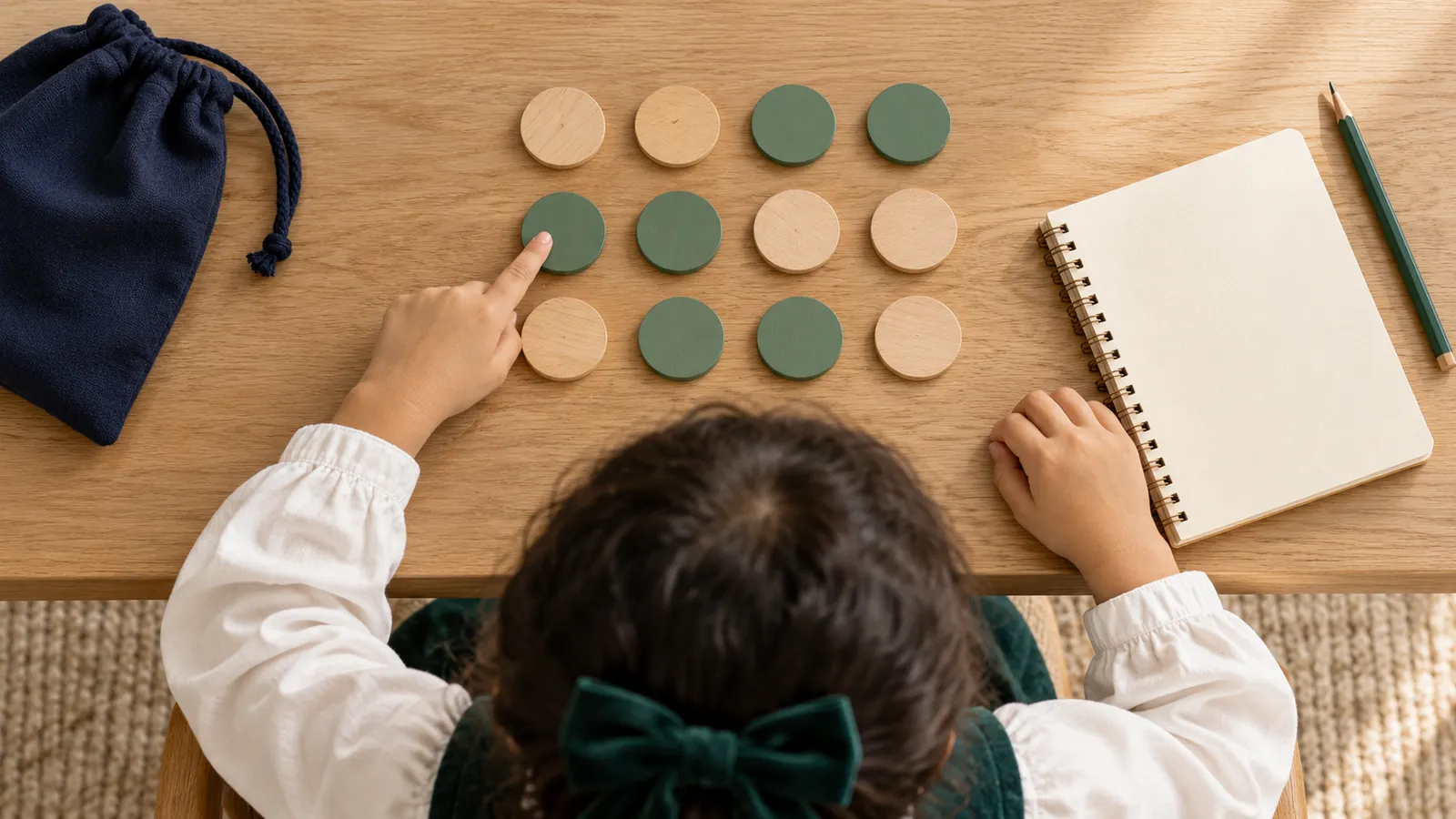
Before a child memorises that 3 × 4 = 12, they should know what it means. At its simplest, multiplication is repeated addition: three groups of four. Use things you have at home, such as buttons, building blocks or dates, and lay them out in rows and columns.
This arrangement reveals something important: 3 × 4 is the same as 4 × 3. Turn the array around and your child can see it for themselves. Suddenly there are far fewer facts to learn than they feared, and that alone takes much of the pressure away.
The Best Order to Teach Times Tables to Kids
Do not simply work through the one times table, then two, then three. A smarter order starts with the easiest tables and builds on them:
- The 1 and 10 times tables. One keeps the number the same; ten adds a zero.
- The 2 and 5 times tables. Two is doubling; five always ends in 0 or 5 and is half of the ten times table.
- The 4 and 8 times tables. Four is double two, and eight is double four.
- The 3 and 6 times tables. Six is double three.
- The 9 times table. It has a lovely pattern: the digits of each answer add up to 9, and the tens go up by one as the units go down by one.
- The 7 times table last. By the time your child reaches it, they already know most of its facts from the other tables.
Focus on one or two tables a week, and only move on once the previous one feels quick and comfortable.
Fun Ways to Practise Times Tables
Repetition matters, but it does not have to be boring. Try these ideas:
- Flashcards. Question on one side, answer on the other. Put the facts your child knows in one pile and the shaky ones in another pile to revisit.
- Dice games. Roll two dice and multiply the numbers; the fastest correct answer wins a point.
- Skip counting with movement. Count 3, 6, 9, 12 while jumping or clapping on each number.
- Songs and rhythm. Chanting a table to a simple tune helps many children remember.
- Questions on the go. Two or three quick facts in the car or while waiting for dinner.
- Real-life problems. "Each box has 6 pencils and we have 4 boxes. How many pencils is that?"
A Short Daily Routine Makes the Difference
The secret is consistency, not long sessions. Ten minutes a day is far more effective than one long hour at the weekend. A few guiding principles help:
- Mix older facts with new ones in every session so nothing is forgotten.
- Aim for accuracy first and speed second. Do not race the clock until your child trusts their answers.
- Teach strategies for working facts out. If they forget 7 × 8, they can work out 7 × 4 and double it.
- Celebrate progress. A chart on the fridge where your child colours in each table they have mastered gives clear motivation.
Avoid comparing your child with siblings or classmates; every child has their own pace, and steady progress is what counts. For more ideas on supporting learning at home, read our article on foundation learning in maths, Arabic and English.
When a Foundations Program Can Help
If a child still finds addition and subtraction difficult, times tables will usually be a struggle too, because the groundwork is not yet in place. A structured foundations program that starts from your child's real level can make a big difference.
At Nova Educational Center in Umm Salal Mohammed, our Maths Foundations program for ages 6 to 10 runs for 12 sessions at 900 QAR (instead of 1100). It includes the student book and Nova curricula, regular progress tracking, and moving up levels by mastery rather than by time, and it begins with a free level check at the centre. If you would also like foundations in Arabic and English, the Integrated Foundation Bundle combines all three programs at 10% off: 2430 QAR instead of 2700. See our current offers for details.
Help your child learn their times tables with confidence and enjoyment: explore our Foundations programs and choose the right one, or message us on WhatsApp and we will help you get started.