Help Your Child with Maths Homework Without Doing It for Them
How to help your child with maths homework without doing it for them: guiding questions, a calm routine, and signs they may need extra support.
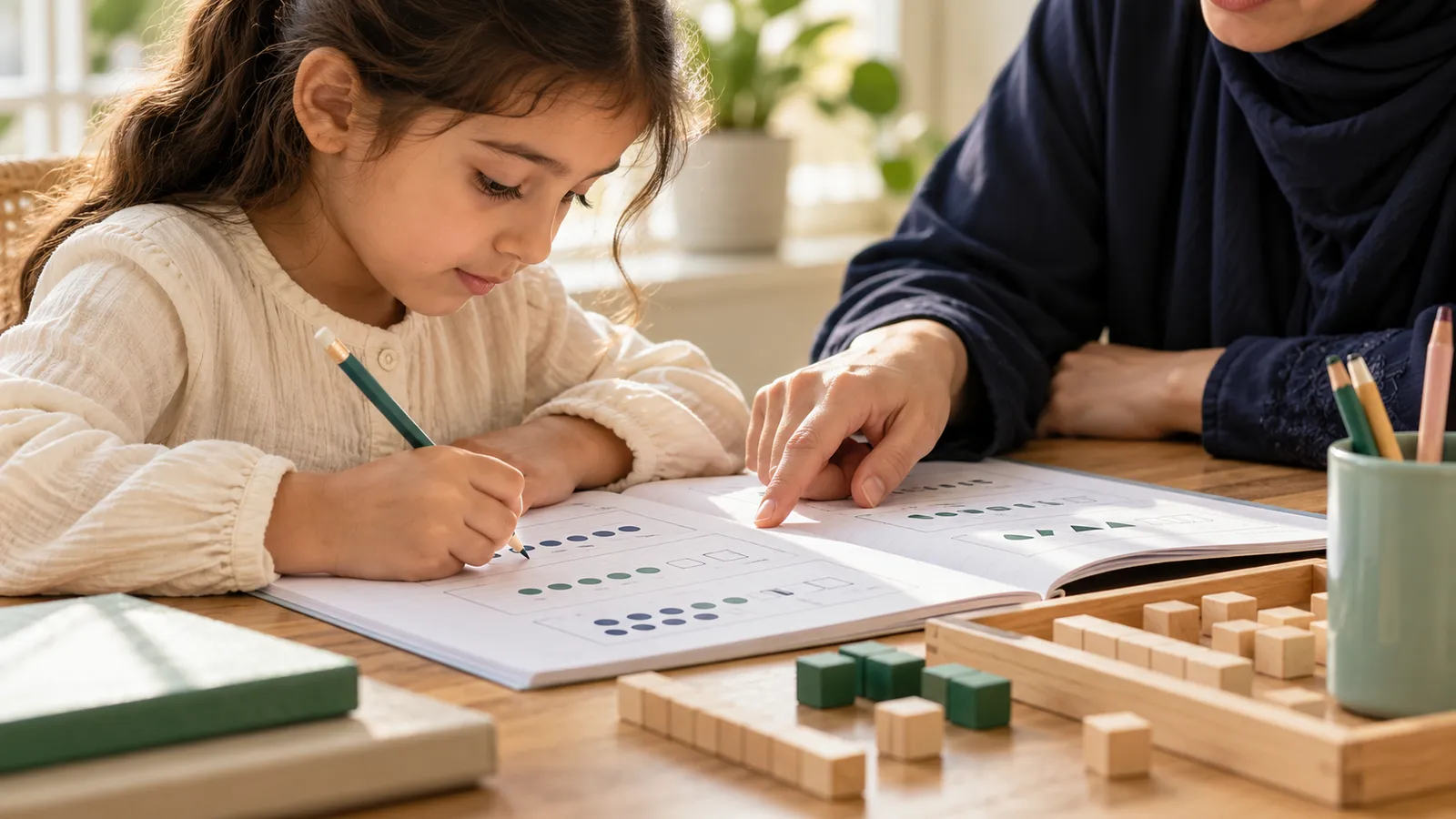
Most evenings, parents across Qatar sit beside an open maths exercise book and face the same dilemma: how do you help your child with maths homework without ending up doing it yourself? The answer is a balance. Be present and supportive, but leave your child the space to think, try and get things wrong. This article offers practical steps to make homework time calmer and far more useful.
Why Doing Their Maths Homework Backfires
Homework is not the goal in itself. It is a chance for your child, and their teacher, to see what has been understood and what has not. When a parent solves the problems, the book goes back complete and correct, the teacher assumes the topic is secure, and the real gap stays hidden until it grows with the next unit. Children also learn, quietly, that difficulty means waiting to be rescued rather than looking for a way through.
There is a second problem. Your method may differ from the one taught at school, and switching between two approaches can leave a child more confused than before. Your most valuable role is to guide, not to do.
How to Help Your Child with Maths Homework Using Questions
The most powerful tool you have is a good question. Instead of explaining the solution, try asking:
- What exactly is the question asking? Can you say it in your own words?
- What information are you given, and which parts do you need?
- Have you solved something similar in class? How did you start that one?
- Could you draw it, or show it with objects around the house?
- How can you check that your answer makes sense?
If your child is still stuck, offer a small hint rather than the whole step, and then wait. A few seconds of silence gives them time to think, and that is often exactly what they need. If they make a mistake, do not correct it straight away. Ask them to explain how they reached their answer; children frequently spot the error themselves while talking it through.
Building a Calm Homework Routine
Routine and environment do half of the work:
- A fixed time each day, after a short break and a snack once they are home from school.
- A quiet space without screens, with the basics ready: pencils, a ruler and scrap paper for working out.
- Start with the easier questions so your child builds confidence, then move on to the harder ones.
- Short bursts for younger children. Twenty minutes of genuine focus beats an hour of distraction.
- Praise effort and strategy, not cleverness. "I liked how you tried a different way" does more good than "you're so smart".
Watch your own words too. "I was never good at maths either" may sound comforting, but it tells a child that struggling is fixed and trying is pointless. Something like "This one needs some thinking, so let's work at it together" sends a far better message.
Bring Maths into Everyday Life
Maths does not have to live only in the exercise book. Ask your child to work out the change when you shop, compare prices at the supermarket, share sweets fairly between siblings, or estimate how long a car journey will take. These small moments build number sense and connect classroom learning to real life.
For younger children especially, secure basic arithmetic and times tables are the most important things to build at this stage. Our article on foundation learning in maths, Arabic and English explains why early foundations matter so much.
When Your Child Needs Extra Support
Sometimes help at home is not enough, and that is completely normal. Look out for these signs:
- Homework regularly takes far longer than it should.
- The same mistake keeps coming back despite explanations.
- Your child avoids maths or becomes anxious when it comes up.
- Maths marks are slowly slipping.
Often the real issue is a gap in an earlier skill rather than the current topic. Knowing your child's true level before choosing a solution makes all the difference, whether that means a center program or private lessons; we compare the two in private tutoring vs a center program. At Nova Educational Center in Umm Salal Mohammed, our Foundations and Academic Support programs start from each child's level and track progress along the way.
If you feel your child needs more than homework help at home, take one clear step: explore our Foundations and Academic Support programs, or message us on WhatsApp to arrange a level check at the centre and a recommendation for the right program.